
Table of Contents
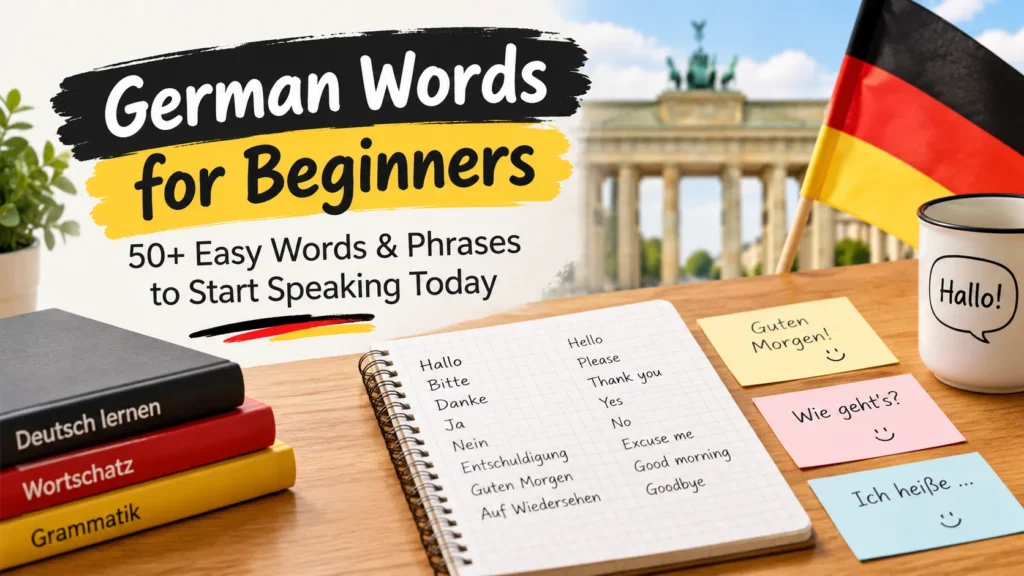
ToggleGerman words for beginners work best when they come with sound and context. This guide gives you 55 German words and phrases, each with an English meaning, a simple pronunciation, and an example sentence. Think of it as a German vocabulary list you can use.
You’ll learn greetings, numbers from 1 to 20, easy German words for everyday objects, and basic German phrases for introducing yourself and asking for help. The words suit CEFR level A1, the first level of German, which the Goethe-Zertifikat A1 exam tests. Take one section at a time and say every word aloud, whether you’re heading to Germany, Austria, or Switzerland.
Table of Contents
- What Are the Most Useful German Words for Beginners?
- Basic German Greetings for Everyday Conversations
- German Numbers 1 to 20 for Beginners
- Easy German Words for Everyday Objects
- 10 Basic German Phrases for Beginners
- How to Pronounce German Words
- How to Learn These German Words Faster
- Frequently Asked Questions
- Key Takeaways
- Start Building Your German Vocabulary
What Are the Most Useful German Words for Beginners?
The most useful German words for beginners are the ones you hear every day: greetings, numbers, common objects, and short phrases. You can use them in almost any situation.
German nouns are masculine, feminine, or neuter, so learn every noun with its article: der, die, or das. Learn der Tisch, not just Tisch, and you’ll remember the gender from day one.
In the pronunciation column, the stressed syllable is in capitals. KH is a throaty “h”, and EW is an “ee” with rounded lips.
Basic German Greetings for Everyday Conversations
Pick a greeting by the time of day and how well you know the person.
German | English | Say it like |
Hallo | Hello | HAH-loh |
Guten Morgen | Good morning | GOO-ten MOR-gen |
Guten Tag | Good day / Hello | GOO-ten TAHK |
Guten Abend | Good evening | GOO-ten AH-bent |
Gute Nacht | Good night | GOO-teh NAHKHT |
Tschüss | Bye | CHEWSS |
Auf Wiedersehen | Goodbye | owf VEE-der-zay-en |
Ja / Nein | Yes / No | YAH / NINE |
Danke | Thank you | DAHN-keh |
Bitte | Please / You’re welcome | BIT-teh |
Tschüss is casual, while Auf Wiedersehen is the polite way to say goodbye.
German has two words for “you.” Use du (say “doo”) with friends, family, and people your age. Use Sie (say “zee,” always capital S) with strangers and in formal settings. So it’s Wie geht es dir? (vee GAYT es DEER) with a friend, and Wie geht es Ihnen? (vee GAYT es EE-nen) with Herr Müller.
German Numbers 1 to 20 for Beginners
Numbers help with prices, ages, dates, and phone numbers.
Number | German | Say it like |
1 | eins | EYENS |
2 | zwei | TSVY |
3 | drei | DRY |
4 | vier | FEER |
5 | fünf | FEWNF |
6 | sechs | ZEKS |
7 | sieben | ZEE-ben |
8 | acht | AHKHT |
9 | neun | NOYN |
10 | zehn | TSAYN |
11 | elf | ELF |
12 | zwölf | TSVUHLF |
13 | dreizehn | DRY-tsayn |
14 | vierzehn | FEER-tsayn |
15 | fünfzehn | FEWNF-tsayn |
16 | sechzehn | ZEKH-tsayn |
17 | siebzehn | ZEEP-tsayn |
18 | achtzehn | AHKHT-tsayn |
19 | neunzehn | NOYN-tsayn |
20 | zwanzig | TSVAN-tsikh |
From 13 to 19, add -zehn, like the English “-teen”: drei + zehn = dreizehn. Sechs and sieben lose letters in sechzehn and siebzehn. Elf and zwölf are their own words.
Easy German Words for Everyday Objects
Learn each noun with its article.
German | English | Say it like | Example |
das Wasser | water | dahs VAH-ser | Ich trinke Wasser. – I drink water. |
das Brot | bread | dahs BROHT | Das Brot ist frisch. – The bread is fresh. |
das Haus | house | dahs HOWSS | Das Haus ist groß. – The house is big. |
das Auto | car | dahs OW-toh | Das Auto ist neu. – The car is new. |
das Buch | book | dahs BOOKH | Ich lese ein Buch. – I am reading a book. |
der Tisch | table | dair TISH | Der Tisch ist rund. – The table is round. |
der Stuhl | chair | dair SHTOOL | Der Stuhl ist bequem. – The chair is comfortable. |
die Tür | door | dee TEWR | Die Tür ist offen. – The door is open. |
das Fenster | window | dahs FEN-ster | Das Fenster ist klein. – The window is small. |
das Telefon | phone | dahs teh-leh-FOHN | Mein Telefon klingelt. – My phone is ringing. |
die Tasche | bag | dee TAH-sheh | Die Tasche ist schwer. – The bag is heavy. |
der Schlüssel | key | dair SHLEW-sel | Wo ist mein Schlüssel? – Where is my key? |
die Uhr | clock / watch | dee OOR | Es ist zehn Uhr. – It is ten o’clock. |
der Zug | train | dair TSOOK | Der Zug kommt pünktlich. – The train arrives on time. |
die Straße | street | dee SHTRAH-seh | Die Straße ist lang. – The street is long. |
10 Basic German Phrases for Beginners
These ten cover introductions, asking for help, and everyday situations.
German | English | Say it like | Example |
Ich heiße… | My name is… | ikh HY-seh | Ich heiße Sofia. – My name is Sofia. |
Wie heißt du? | What is your name? | vee HYST doo | Hallo, wie heißt du? – Hi, what’s your name? |
Ich komme aus… | I come from… | ikh KOM-eh ows | Ich komme aus Indien. – I come from India. |
Sprichst du Englisch? | Do you speak English? | shprikhst doo ENG-lish | Entschuldigung, sprichst du Englisch? – Excuse me, do you speak English? |
Ich verstehe nicht. | I don’t understand. | ikh fer-SHTAY-eh nikht | Entschuldigung, ich verstehe nicht. – Sorry, I don’t understand. |
Entschuldigung. | Excuse me / Sorry | ent-SHOOL-dee-goong | Entschuldigung, wo ist der Bahnhof? – Excuse me, where is the train station? |
Es tut mir leid. | I am sorry. | es TOOT meer LITE | Es tut mir leid, ich komme zu spät. – I’m sorry, I’m late. |
Alles klar. | Okay / Got it | AH-les KLAHR | Alles klar, danke. – Okay, thanks. |
Ich möchte… | I would like… | ikh MUHKH-teh | Ich möchte einen Kaffee. – I would like a coffee. |
Wo ist die Toilette? | Where is the toilet? | voh ist dee toy-LET-teh | Wo ist die Toilette, bitte? – Where is the toilet, please? |
How to Pronounce German Words
German spelling is more regular than English, so a few patterns go a long way.
Letters | Sound | Example |
w | like English “v” | wie (VEE) |
v | usually like “f” | vier (FEER) |
z | like “ts” | zwei (TSVY) |
ei | like “eye” | eins (EYENS) |
ie | like “ee” | wie (VEE) |
eu | like “oy” | neun (NOYN) |
sch | like “sh” | Tasche (TAH-sheh) |
st / sp at the start | like “sht” / “shp” | Stuhl (SHTOOL) |
ß | like “ss” | Straße (SHTRAH-seh) |
ü | “ee” with rounded lips | Tür (TEWR) |
ö | “eh” with rounded lips | möchte (MUHKH-teh) |
ch | soft or harder, depending on the word | ich, acht |
The sounds ü and ö have no exact English match, so these respellings are close, not perfect. In ich, ch is a soft hiss at the front of the mouth; in acht, it’s stronger and comes from the back of the throat.
German also capitalises every noun: das Buch, die Straße, der Tisch.
How to Learn These German Words Faster
Words stick when you use them, not when you only read the list.
1. Learn words in groups
Start with greetings, then numbers, nouns, and phrases.
2. Learn nouns with their articles
Learn der Tisch and das Buch, not just Tisch and Buch.
3. Say every word aloud
Read it, check the pronunciation, and repeat it a few times.
4. Build simple sentences
Combine words: Ich trinke Wasser. Das Auto ist neu.
5. Review regularly
Short, regular sessions beat memorising a whole German vocabulary list in one sitting.
Start Building Your German Vocabulary
You now have 55 German words and phrases to work with, plus the pronunciation rules that help you read new words. That’s enough to greet people, count to twenty, name everyday things, and ask for help.
Words only stick when you use them. Say a few aloud each morning, put the article before every noun, and turn each new word into a short sentence, like Ich trinke Wasser. Give ü and ö extra time, and listen to native speakers when you can. When these words feel natural, add grammar, listening, and speaking practice to work toward A1 German with expertise of Grace Academy.
Frequently Asked Questions
How many German words should you learn as a beginner?
There is no fixed number of words that every beginner needs. A practical starting point is to learn common words and phrases that can be used in everyday situations, then gradually expand your vocabulary.
What German words should I learn first?
Start with common greetings, numbers, everyday nouns, polite expressions, introductions, and simple questions. Words such as Hallo, Danke, Bitte, and Entschuldigung are useful early vocabulary.
What is the easiest German word to learn?
Hallo is an easy starting word for many English speakers because it is similar to the English “hello” and is widely used as an informal greeting.
Is German difficult for English speakers?
German and English are both Germanic languages, so they share some vocabulary and linguistic similarities. However, German has grammatical features that beginners need to learn, including noun genders, cases, and changes in word order.
How much time is usually needed to learn German at A1 level?
The time required to reach A1 German varies from person to person. Previous language experience, study frequency, course structure, and the amount of practice can all affect progress.