

Table of Contents
ToggleSelf study for IELTS is doable— but not for everyone. Some students clear Band 7 or higher studying entirely on their own. Others spend months preparing alone and still plateau at Band 6 or 6.5. The difference usually comes down to English background, available study time, and one honest challenge: getting real feedback on Writing and Speaking.
This guide is for students in Kerala, working nurses, and professionals who are genuinely unsure whether to go for coaching or try self-preparation first.
Can You Prepare for IELTS Without Coaching?
Yes, you can prepare for IELTS without joining any coaching centre. Thousands of candidates do it every year using structured resources and consistent practice. The British Council and IDP IELTS both offer free official practice materials on their websites. Cambridge IELTS Books (1 through 19) remain the most trusted source for authentic practice tests.
Self study for IELTS tends to work best for:
- Candidates with a strong English foundation (reading English regularly, comfortable in English conversations)
- Working professionals who cannot attend fixed class schedules
- Students retaking IELTS who already know the format and just need practice
- People who scored above 6 in a mock test without any preparation
- Nurses or graduates from English-medium colleges who use English daily at work
If you fit two or more of the above, self study is a reasonable starting point. The key is not just studying hard — it is studying the right things in the right order.
When Does Self Study for IELTS Become Difficult for Students?
Most self study plans start well. The problem usually appears around weeks three or four, when students hit their first Task 2 essay and have no idea if it is actually good.
1. Lack of Writing Feedback
Writing is the hardest module to self-evaluate. You can read model answers, follow templates, and write five essays a week — but without someone reviewing your coherence, grammar range, and task response, you are largely guessing. Many students in Kerala score between 5.5 and 6 in Writing even after two months of self-study because they never got a single essay corrected. IELTS Liz and similar YouTube educators give good structural advice, but they cannot read your essay and tell you what you specifically need to fix.
2. Speaking Practice Limitations
Speaking requires a real conversation partner. Practicing alone in front of a mirror improves fluency slightly, but it does not replicate the pressure of an actual examiner. AI tools like ChatGPT can help you practise answers and get vocabulary suggestions, but they cannot accurately score your pronunciation or assess your natural conversational rhythm.
3. Too Much Free Information Online
This one surprises people. There is so much IELTS content online — YouTube channels, Telegram groups, websites, PDFs — that students often waste hours deciding what to study instead of actually studying. Without a clear plan, information overload becomes a serious problem. It is easy to spend three weeks watching videos and feel productive without actually improving your band score.
Self Study for IELTS vs Coaching: Which Gives Faster Results?
Both approaches can work. The honest answer is that results depend more on the individual student than on the method. The biggest advantage of coaching is not the teaching – it is the accountability and feedback loop. A trainer who reviews your writing weekly will catch repeated errors that you might never notice on your own. Here is a realistic comparison:
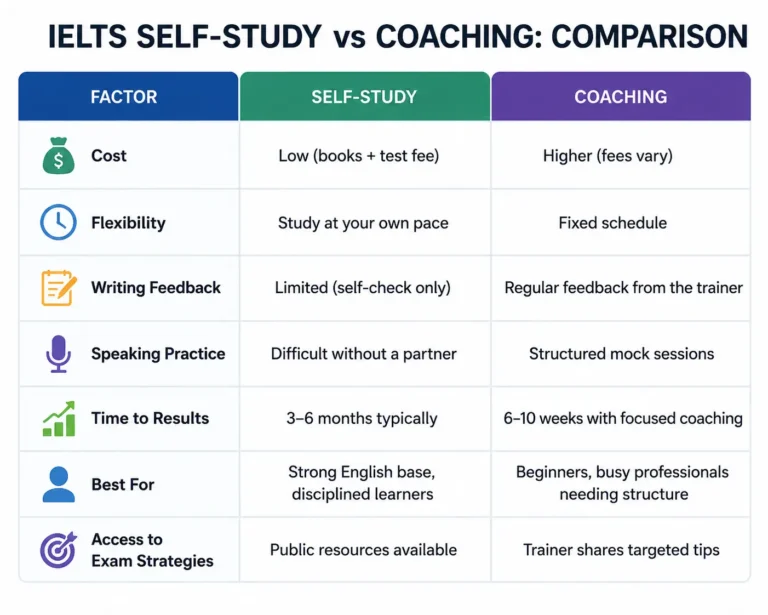
Studying IELTS at Home: The Right Way to Structure Your Preparation
Structure is what separates students who improve from those who stay stuck. Sitting down to “study IELTS” without a clear plan for that session is one of the most common reasons self-study fails. Two focused hours beat five aimless ones — every time.
1. Build a Study Plan Around Your Test Date
Fix your exam date first, then count backwards. If you have 10 weeks, you have roughly 70 sessions to work with. Break them by module and by week – not just by day. A student preparing for a mid-October test, for example, should be doing full-time practice tests by week eight, not still watching strategy videos. Assign specific modules to specific days and treat it like a class schedule you cannot skip.
2. Stick to Official IELTS Resources
Cambridge IELTS Books 13 through 19 are the closest thing to the real exam you will find. The question formats, timing, and difficulty levels match what the British Council and IDP IELTS actually use. Avoid question banks from random websites — many have outdated formats or inaccurate answer keys. The British Council’s free practice portal and IDP’s sample tests are worth bookmarking from day one.
3. Make Speaking Practice a Daily Habit
Speaking is the one module most home-study students avoid because it feels awkward to practise alone. Record your Part 2 answers on your phone. Listen back and catch filler words, long pauses, or repeated vocabulary. Use ChatGPT to run a mock Part 1 conversation and push yourself to give fuller, more detailed answers. Even 10 minutes of spoken English daily adds up significantly over eight weeks.
4. Attack Your Weakest Module First
Most students naturally drift toward what they are already comfortable with. If Reading feels easy, you will find yourself doing Reading practice every day, while Writing gets ignored. Identify your weakest area in the first week – take a diagnostic test – and give it the most time. Writing and speaking almost always need the most attention for home-study candidates, so front-load them in your weekly plan.
Signs You May Need IELTS Coaching
Some students genuinely benefit more from coaching than from self-study. Consider joining a coaching programme if:
- You have been stuck at Band 6 or 6.5 for two attempts or more
- You are not sure why your Writing score is low despite regular practice
- Speaking makes you anxious and you avoid practising it
- You have less than eight weeks before your test date
- You work long hours and cannot maintain a consistent self-study routine
- English is not a regular part of your daily life or work
- You have attempted IELTS before without any structured preparation
The Band 6.5 plateau is real. Many nurses and graduates in Kerala hit this band and cannot move past it without specific feedback on their errors. This is where a trainer’s input makes a measurable difference.
Final Verdict: Is Self-Study for IELTS enough?
Self-study is enough for some candidates — specifically those with a strong English base, structured discipline, and access to quality resources. It is not a guaranteed path for everyone, and it has real gaps in Writing and Speaking feedback.
Coaching is not a necessity, but it does accelerate progress for those who are stuck, short on time, or lacking confidence in productive practice. The two approaches are not opposites — many students do both: self-study for Reading and Listening, and coaching for Writing and Speaking feedback only.
At Grace Academy, we have worked with students who cleared Band 7.5 through self study and others who needed six weeks of focused coaching to cross Band 7. There is no single right answer. What matters is an honest assessment of where you are right now.
Frequently asked questions
Can I score Band 7 in IELTS without coaching?
Yes. Scoring Band 7 without coaching is possible, particularly for candidates who already use English regularly. A consistent 8 to 10 week self-study plan using Cambridge IELTS books, regular writing practice with self-assessment, and daily speaking rehearsal can get you there. However, Writing feedback remains the biggest gap in self-study, so finding a peer reviewer or online correction service helps significantly.
How many months are enough for IELTS self-study?
For most candidates, 2 to 3 months of focused daily study (1.5 to 2 hours) is enough to be exam-ready. Candidates starting from a lower English base may need 4 to 6 months. The timeline depends more on study quality than study duration. Practising one full test per week and reviewing every answer carefully matters more than total hours spent.
Which IELTS module is hardest during self-study?
Writing is consistently the hardest module to improve through self-study. Task 2 essays require understanding of coherence, lexical range, and task response — all of which are difficult to self-assess accurately. Speaking is a close second, mainly because it requires live interaction that is hard to replicate alone. Reading and Listening are far more manageable with independent practice
Is YouTube enough for IELTS preparation?
YouTube is a useful supplement, not a complete preparation tool. Channels like IELTS Liz give solid explanations of question types, strategies, and common errors. However, YouTube cannot replace timed practice tests, written feedback on your essays, or live speaking evaluation. Use it to understand concepts and strategies, then practice with official Cambridge materials to consolidate what you learn.