
Table of Contents
ToggleMost IELTS candidates spend months preparing without a clear system. They study hard, but they study without direction.
That gap — between effort and outcome — is exactly where AI tools make a difference.
In 2026, students preparing for IELTS have access to something previous generations never had: intelligent, on-demand feedback that adapts to them personally. No waiting for a tutor. No guessing whether an essay is good enough. The feedback arrives instantly, and it improves with every session.
This guide covers the ten most effective AI tools for IELTS preparation this year — what each one does best, how to use it correctly, and how to combine them into a study system that actually works.
What makes AI tools genuinely useful for IELTS preparation
AI tools are useful for IELTS because they remove two of the biggest obstacles to progress: delayed feedback and lack of practice opportunities.
Traditional IELTS preparation depends on scheduled lessons, periodic essay reviews, and sporadic speaking practice. Learners may go days or even weeks without receiving meaningful feedback on their output.
AI tools solve this by providing immediate, data-driven responses to your speaking, writing, and reading practice — at any hour, on any device.
Beyond feedback speed, AI tools offer something equally valuable: consistency. They evaluate your performance against the same criteria every time. There is no variation in mood, patience, or attention. Students receive structured, repeatable input that builds measurable skills over time.
The best AI tools for IELTS don’t simply flag errors. They explain patterns, track recurring weaknesses, and guide learners toward independent improvement.
The 10 best AI tools for IELTS preparation in 2026
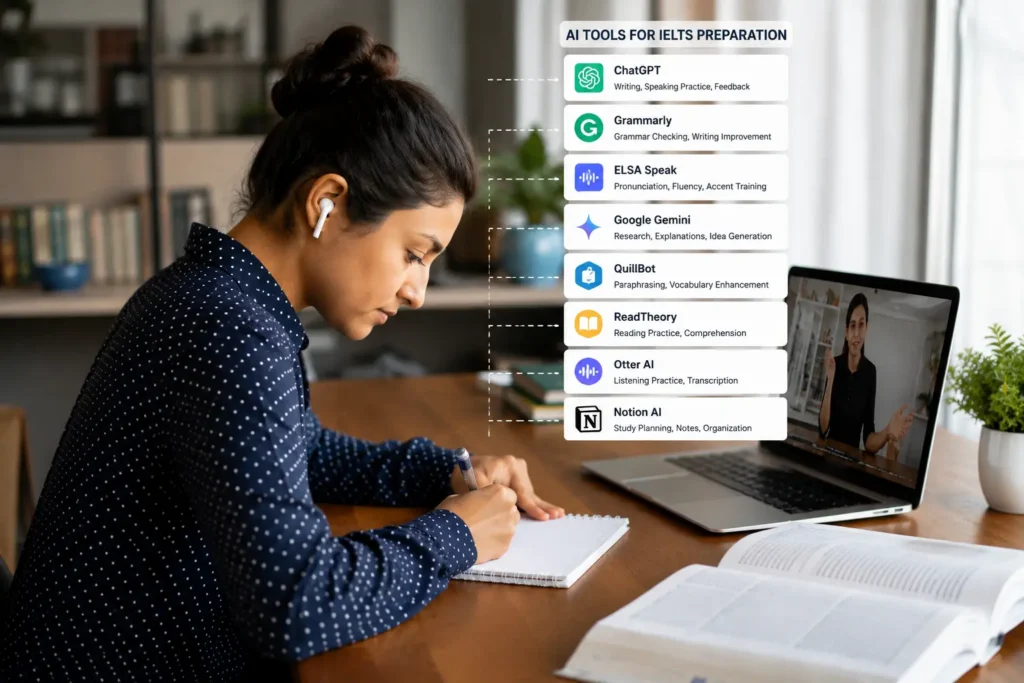
Selecting the right tools depends on your individual challenges and current band score target. The following platforms represent the most effective options available in 2026 across all four IELTS skills.
AI Tool | Primary Skill | Core Advantage |
ChatGPT | Writing & Speaking | Essay analysis and examiner simulation |
ELSA Speak | Speaking | Phoneme-level pronunciation feedback |
Grammarly | Writing | Real-time grammar and clarity coaching |
Google Gemini | Reading & Research | Complex text simplification |
IELTS Ready | All skills | Official test-format practice |
Speechling | Speaking | Human-reviewed pronunciation feedback |
QuillBot | Writing | Sentence restructuring practice |
ReadTheory | Reading | Adaptive comprehension drills |
Otter AI | Listening | Live transcription and review |
Notion AI | Study Planning | Intelligent scheduling and tracking |
Using three or four of these tools consistently produces better results than cycling through all ten randomly.
How to use ChatGPT effectively for IELTS writing and speaking
ChatGPT functions as an on-call language coach — available around the clock and capable of adapting its feedback to your specific needs.
For Writing Task 1 and Task 2, the quality of feedback depends almost entirely on how you frame your prompt. A vague request produces generic suggestions. A precise prompt produces targeted, useful guidance.
Effective ChatGPT prompts for IELTS writing:
- “Analyse this Task 2 essay for coherence and cohesion. Do not rewrite it. List specific issues and explain why each one would affect my band score.”
- “Suggest five alternative vocabulary options for the word ‘important’ that would be appropriate for an academic IELTS essay.”
- “Identify any grammatical errors in this paragraph and explain the rule behind each correction.”
For speaking practice, ChatGPT can simulate a Part 1, Part 2, or Part 3 examiner conversation. Ask it to respond only with follow-up questions, as a real examiner would. Record your spoken answers separately using a voice memo app, then listen back critically.
The most important rule: never submit AI-generated text as your own. Use ChatGPT to understand weaknesses, not to bypass the learning process.
Why pronunciation practice with AI improves IELTS speaking scores
Pronunciation accounts for a significant portion of the IELTS Speaking band descriptors. Many test-takers underestimate how much unclear pronunciation affects their overall score — even when their vocabulary and grammar are strong.
ELSA Speak addresses this directly. The app uses speech recognition trained specifically on non-native English speakers to identify exactly which sounds, syllables, and word stress patterns are unclear. It goes beyond simply marking an answer as “wrong” — it shows learners precisely where their mouth position or intonation differs from standard English.
Speechling complements this by adding human review. Native speaker coaches listen to recordings and provide qualitative feedback that automated systems cannot replicate — nuances around natural rhythm, conversational tone, and pacing.
A practical daily speaking routine using both tools:
- Read a short passage aloud and record it (3 minutes)
- Complete an ELSA Speak pronunciation drill (7 minutes)
- Record a Part 2 speaking response and submit to Speechling (10 minutes)
This 20-minute routine, practiced consistently over eight weeks, produces measurable improvements in fluency and pronunciation clarity.
How AI tools support IELTS reading and listening skill development
Reading and listening are often underestimated in IELTS preparation because candidates assume passive exposure is enough. It is not.
For Reading:
ReadTheory offers adaptive comprehension practice that adjusts difficulty based on your responses. This mirrors the progressive complexity of genuine IELTS Academic reading passages. The platform tracks reading speed and comprehension accuracy simultaneously — both of which affect performance in timed exam conditions.
Google Gemini helps with vocabulary acquisition from complex texts. Paste in a challenging academic passage and ask Gemini to identify high-frequency academic vocabulary, explain meanings in context, and generate example sentences. This builds the reading vocabulary required for Band 7 and above.
For Listening:
Otter AI transcribes spoken audio in real time. Use it to review lectures, podcasts, and recorded discussions. After listening, compare what you heard against the transcript to identify gaps — specific accents, connected speech patterns, or rapid delivery that causes comprehension errors.
This gap analysis is more targeted than general listening practice because it pinpoints exactly where your comprehension breaks down.
How to build a structured study plan with AI tools for IELTS Examination?
A study plan that works is one that can be maintained. Complexity is the enemy of consistency.
The following 60-minute daily schedule uses four AI tools across all four IELTS skills:
Time Block | Activity | Tool |
0–15 mins | Speaking drill and pronunciation | |
15–35 mins | Essay writing and feedback review | |
35–50 mins | Reading comprehension practice | ReadTheory |
50–60 mins | Vocabulary revision and planning | Notion AI |
Set a weekly review session — ideally Sunday — to assess your progress. Track three metrics:
- Writing: average band score estimate from ChatGPT feedback
- Speaking: ELSA Speak pronunciation accuracy percentage
- Reading: ReadTheory comprehension rate
Consistent measurement makes improvement visible, which sustains motivation over the weeks of preparation required for a strong result.
What official IELTS resources should students use alongside AI tools
AI tools are preparation accelerators — not substitutes for authoritative exam resources.
The IELTS examination is designed and administered by British Council, IDP IELTS, and Cambridge English. These organisations publish the official band descriptors, question formats, and marking criteria that determine your final score.
Students targeting Band 6.5 and above should include the following in their preparation:
Official Resource | Purpose |
Official IELTS website | Test structure and format guides |
Cambridge IELTS Books | Authentic timed practice tests |
British Council resources | Free preparation materials |
IDP IELTS learning hub | Sample questions and guidance |
Cambridge practice tests are particularly important. They reproduce the exact style, timing, and question types of a real IELTS exam. AI tools cannot replicate this. Use Cambridge books for timed mock tests and AI tools for targeted skill development between those sessions.
The combination creates a preparation system where weaknesses identified in mock tests get addressed through focused AI-assisted practice.
Common mistakes students make when using AI for IELTS preparation
The biggest risk with AI tools is not overuse — it is misuse.
Substituting AI output for original thinking. Students who ask ChatGPT to write their essays and then memorise the responses are not practising. They are performing. IELTS examiners are trained to identify memorised content, and it does not receive high scores.
Treating feedback as completion rather than a starting point. When ChatGPT identifies a coherence problem in your essay, the correct response is to rewrite the passage yourself — not to accept the AI’s revision. Rewriting is where learning happens.
Rotating through too many tools without depth. Using eight different platforms inconsistently produces less progress than using three platforms consistently. Choose tools that address your specific weaknesses and remain with them long enough to see genuine improvement.
Neglecting timed conditions. AI tools rarely enforce time pressure. Without practising under timed conditions, students often perform significantly worse in the actual exam. Always complete at least two Cambridge practice tests under strict time limits each month.
Are AI tools sufficient for achieving a Band 8 or higher
For most learners, AI tools alone are not sufficient for Band 8 and above.
Band 8 requires a level of language control — in grammar range, lexical resource, and discourse management — that benefits from human assessment. A skilled IELTS tutor can identify subtle errors in register, identify fossilised language habits, and provide feedback on the kind of nuanced communicative competence that automated systems assess imprecisely.
The most effective preparation model for high band scores combines:
- Daily AI-assisted skill practice (speaking, writing, vocabulary)
- Weekly timed mock tests using official Cambridge materials
- Monthly or fortnightly sessions with an experienced IELTS tutor
- Structured review of all feedback — AI-generated and human-given
AI tools dramatically increase the volume and efficiency of practice. Human feedback raises the ceiling of what that practice achieves.
Students who reach Band 7 quickly with AI support often plateau there without additional expert guidance. Planning for that ceiling in advance is part of a realistic high-band preparation strategy.
Key-Takeaways
IELTS preparation in 2026 does not have to follow the patterns of ten years ago — long waits for feedback, expensive tuition, and uncertain progress.
AI tools give learners something genuinely powerful: the ability to practice more, identify weaknesses faster, and improve with greater precision than was previously possible.
The students who benefit most are not the ones who use the most tools. They are the ones who use the right tools consistently, combine them with official IELTS resources, and remain disciplined enough to treat AI feedback as a starting point for further effort — not a finished product.
Start with three platforms. Build a daily routine. Review your progress every week. And treat every session as preparation for the real thing.
Looking for structured learning programs that support your English communication and academic goals? Visit Grace Academy to explore skill development opportunities.
Frequently Asked questions
ELSA Speak provides the most detailed pronunciation analysis, while Speechling adds human feedback for natural fluency development. Using both together covers the full range of speaking skills assessed in IELTS.
ChatGPT provides useful structural and grammatical feedback but does not replicate official IELTS scoring. Use it to identify weaknesses and improve specific elements — not as a reliable band score predictor.
Yes. AI tools are entirely permitted during preparation. They may not be used during the actual test.
Candidates improving by half a band typically need eight to twelve weeks of structured daily practice. Students targeting improvements of one band or more generally require three to four months, combined with official test materials and tutor support.
ChatGPT for writing feedback, ELSA Speak for pronunciation and speaking fluency, and ReadTheory for adaptive reading comprehension practice form a strong foundational combination for most learners.